
The worst responsive communication failures in luxury ground transport usually happen at the worst possible hour. A traveler lands late, the gate changes, the wedding planner is juggling a photographer delay, or a corporate assistant is trying to move three cars without waking the client. In those moments, the client does not care how many messages your team sent. They care whether the right person responded fast enough, with the right detail, on the right channel, and without making them repeat the whole story.
That is what separates a calm operation from a noisy one. In luxury ground transport, responsive communication is not a reply-time contest. It is a reliability system built around speed, accuracy, and channel fit. The teams that handle it well make the experience feel controlled, even when the itinerary changes underneath them.
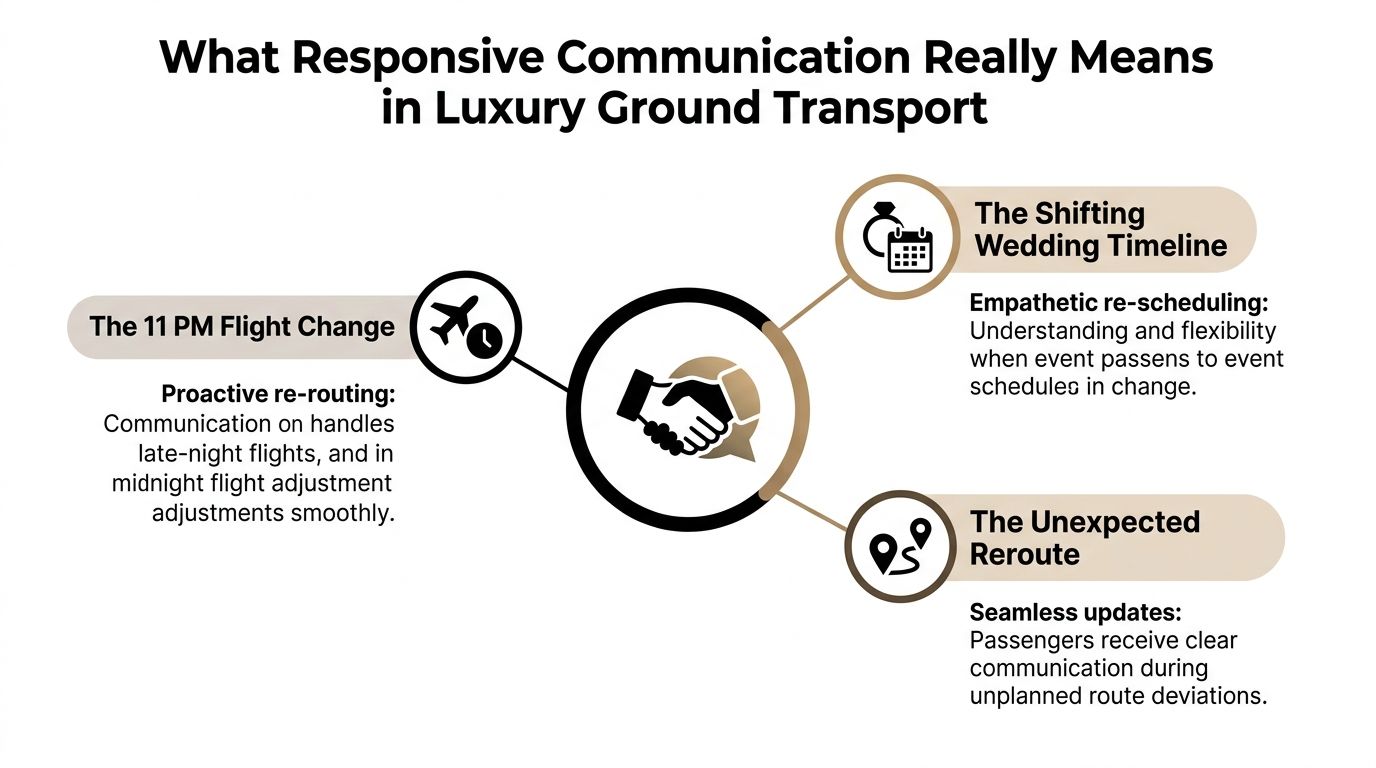
What Responsive Communication Really Means in Luxury Ground Transport
A flight change at 11 p.m. tells you everything about this business. The client is tired, the chauffeur is already staged, and the dispatcher is deciding whether to text, call, or push a new ETA through the booking record. If your team only measures how fast someone typed a reply, you can still fail the client badly.
The difference between fast and responsive
A 2022 peer-reviewed study found that response times under 250 milliseconds are short enough to preclude conscious control, which makes them an “honest signal” that people use to judge how well two people click, and faster conversations felt more connected across three studies (PMC study on conversational response speed). That matters in luxury transport because clients read responsiveness as a trust cue, not just a convenience.
Practical rule: if the client feels they have to chase you, your operation already feels less premium.
In this business, responsiveness has three jobs. First, it has to handle urgent issues quickly enough to protect the trip. Second, it has to keep logistics accurate so no one gets the wrong terminal, wrong pickup point, or wrong vehicle. Third, it has to keep a human tone during emotional moments, like a delayed arrival, a wedding timeline shift, or a VIP change that affects multiple passengers.
A quick reply that doesn't solve the problem is not responsive communication. Neither is a beautifully worded email that arrives after the client has already made other arrangements. The standard is simpler. The client should feel informed, understood, and covered.
What luxury clients actually judge
Luxury travelers and event planners are asking three quiet questions all the time. Do you know what changed? Do you know what to do next? Do I need to worry again?
A useful way to train staff is to align message style with the job the message is doing. The operational detail can be terse. The emotional moment needs warmth. The handoff between them needs continuity so the client never feels dropped by the system. For a manager trying to explain this internally, the SMB team alignment tips resource is a practical reference for tightening ownership across a small team.
Choosing the Right Channel for Each Moment
The fastest way to damage responsiveness is to treat every channel like it does the same job. It doesn't. A phone call, an SMS, an email, a branded app, and dispatch software each belong in a different part of the booking lifecycle. When a team assigns each channel a purpose, the operation feels faster even when no one is typing faster.
Put each channel to work where it earns its keep
Phone is for urgency and emotion. If a passenger is stranded outside baggage claim, or a wedding planner needs a live human because the ceremony start time just moved, the phone is the cleanest route. But phone support only works if someone is available to answer. If not, it becomes a black hole that makes the client feel ignored.
SMS works best for short confirmations, live flight updates, and simple “we're on it” messages. It's quick and usually read fast, but it gets cold when it's used for anything complex. Email is stronger for confirmations, invoices, manifests, and corporate documentation, because it gives the client a record they can forward or archive. A branded app helps with self-service changes and trip tracking, though it breaks down when the user is rushed, offline, or doesn't want to install yet another app.
Dispatch software is the internal nervous system. It should connect reservations, chauffeur assignment, flight tracking, and escalation so the client sees one coherent operation, not three disconnected handoffs.
If the channel is wrong, the response feels slow even when the clock says otherwise.
Channel use by booking lifecycle stage
| Channel | Best For | Avoid When |
|---|---|---|
| Phone | Urgent changes, emotional situations, VIP escalations | The team is understaffed or the issue needs a written record |
| SMS | Flight updates, pickup confirmations, short ETAs | The message needs explanation or negotiation |
| Corporate confirmations, invoices, schedules, formal follow-up | The issue is time-sensitive or the client is already in motion | |
| Branded app | Self-service trip tracking, routine updates, simple modifications | The traveler is under pressure, unfamiliar with the app, or on weak connectivity |
| Dispatch software | Internal ownership, handoffs, live trip status, accountability | Staff are using it as a substitute for client-facing communication |
The trade-off is simple. Phone delivers depth but can collapse if staffing is thin. SMS is efficient but can feel abrupt without context. Email gives structure but can be ignored if it's too long or too late. The app is useful when the client wants control, but it should never be the only path.
For a dispatcher, the five-second rule is this. If the issue is urgent or emotional, call. If it's short and time-sensitive, text. If it needs a record, email. If the client can solve it themselves, push it into the app. If the team needs to coordinate it, log it in dispatch first.
Response Time Standards and SOPs Your Team Can Actually Hit
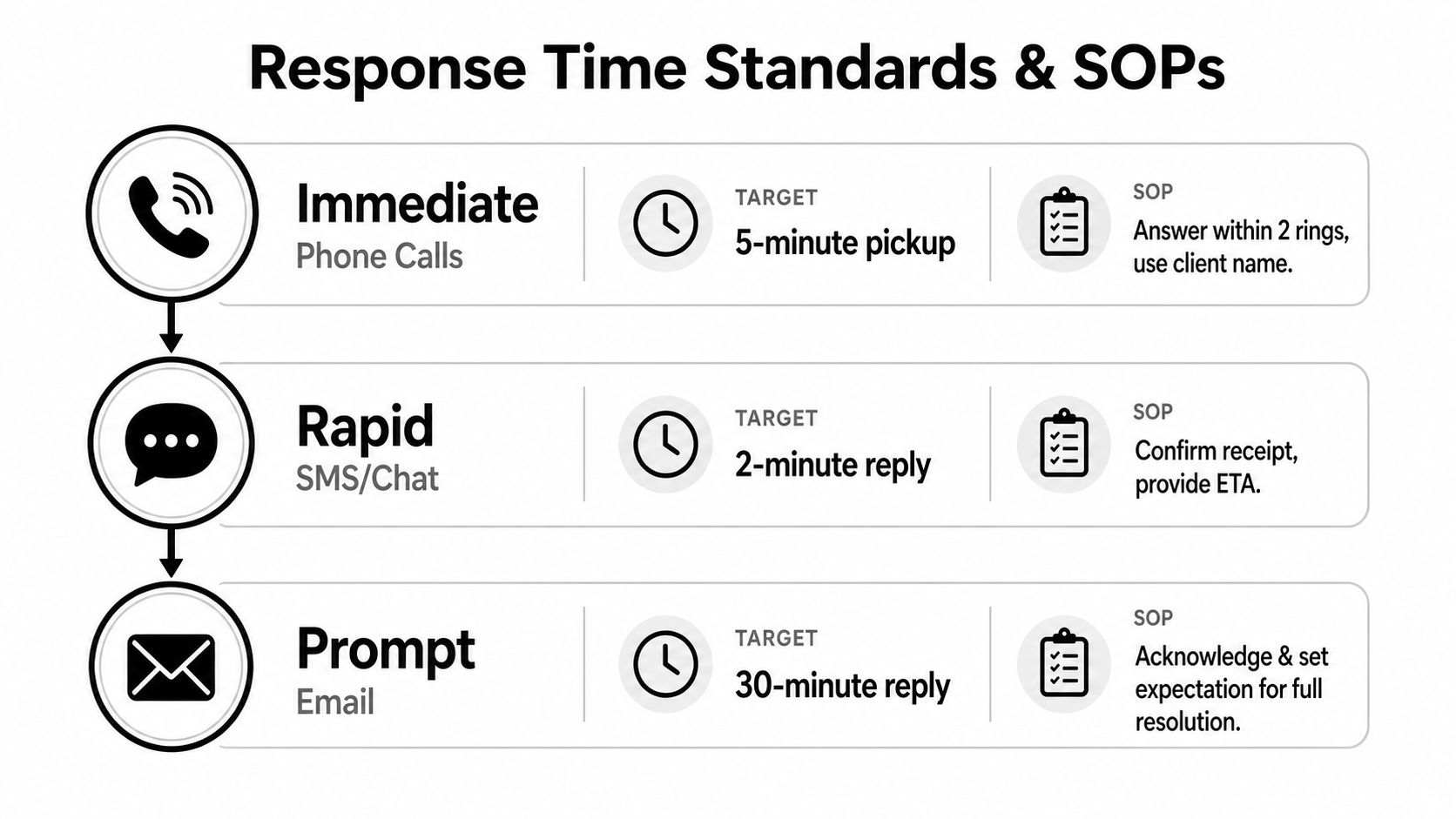
“Reply fast” is not a standard. It's a wish. The difference between a polished operation and a stressed one is that the polished operation has rules people can follow on a busy night, when the phones are ringing, the airport is shifting, and someone just sent a route change from a moving car.
Build standards that map to channel pressure
A practical target set looks like this. Incoming calls should be picked up within 5 minutes. SMS should get a reply within 2 minutes during business hours. Email should be acknowledged within 15 minutes. Automated confirmations should go out instantly. Those targets are only useful if you build the staffing and handoff rules behind them.
The phone tree needs a named owner, not a vague “whoever is free” approach. Shared inboxes need one person watching them at a time, even if another staff member is writing the actual reply. Dispatch should update the chauffeur without forcing the client to repeat context, which means the reservation note, the live trip status, and the client preference should all travel together.
The escalation matrix should be boring on purpose
Rule of thumb: if the answer affects money, timing, or a VIP preference, pull in a supervisor before the client has to ask twice.
Here's the escalation logic that keeps seams hidden:
- Agent handles it directly when the issue is routine, the script exists, and no service exception is involved.
- Supervisor joins when the request changes pricing, vehicle class, timing, or client expectations.
- Operations lead takes over when the trip affects multiple passengers, airport sequencing, or a high-stakes event timeline.
- Owner or senior manager steps in when the client is unhappy, the schedule is breaking, or the operation has already missed a commitment.
Documentation matters because handoffs create memory gaps. If the record shows who owned the trip, who approved the change, and what the client was told, the next person can continue the conversation without making the client restart from zero.
Scripts and Templates That Sound Like a Person, Not a System
The best scripts in luxury transport sound calm, specific, and human. They don't feel written by a committee. They feel like a trained coordinator who knows what matters, knows what's already been handled, and doesn't waste the client's time.
Booking confirmations and live delay updates
A confirmation message should do four things, name the service, state the pickup point, confirm the timing, and give a clean way to reach the team. For example: “Your sedan is confirmed for Tuesday at 6:40 a.m. at the west curb of Terminal 5. We'll send a driver update before pickup, and if your flight changes, reply here or call us.”
A delay update needs fewer words, not more. “Your flight has moved forward, so we're adjusting the pickup window now. The chauffeur assignment is being updated, and I'll send the new timing in a few minutes.” That wording matters because it acknowledges the change without sounding alarmed.
Wedding timelines and corporate roadshow changes
Wedding communication needs empathy first and logistics second. “We've updated the arrival sequence so the bridal party stays on schedule. Your chauffeur will follow the new timeline exactly as shared, and we'll keep the planner updated if anything shifts again.” The language is calm because the client is already carrying emotional load.
Corporate roadshow changes are different. They need precision and brevity. A strong version sounds like this. “The meeting ended early, so we've advanced the pickup by 90 minutes. Your vehicle will now stage at the updated location at 2:15 p.m., and your coordinator has the revised itinerary.”
For operators building templates inside a CRM, the goal is to keep a few fixed blocks and a few variable fields. Fixed blocks cover confirmation, acknowledgement, and next step. Variable fields hold the client name, vehicle type, flight number, or pickup address. That mix keeps the tone consistent without sounding robotic.
Max's Luxury Rides Inc. fits this model naturally because it already supports direct contact by phone and email, which gives a dispatcher usable fallback paths when a client needs a live response or a written record. The channel mix only works if each message opens with the context the client would otherwise have to repeat.
Automation and Human Handoff Rules for 24/7 Coverage
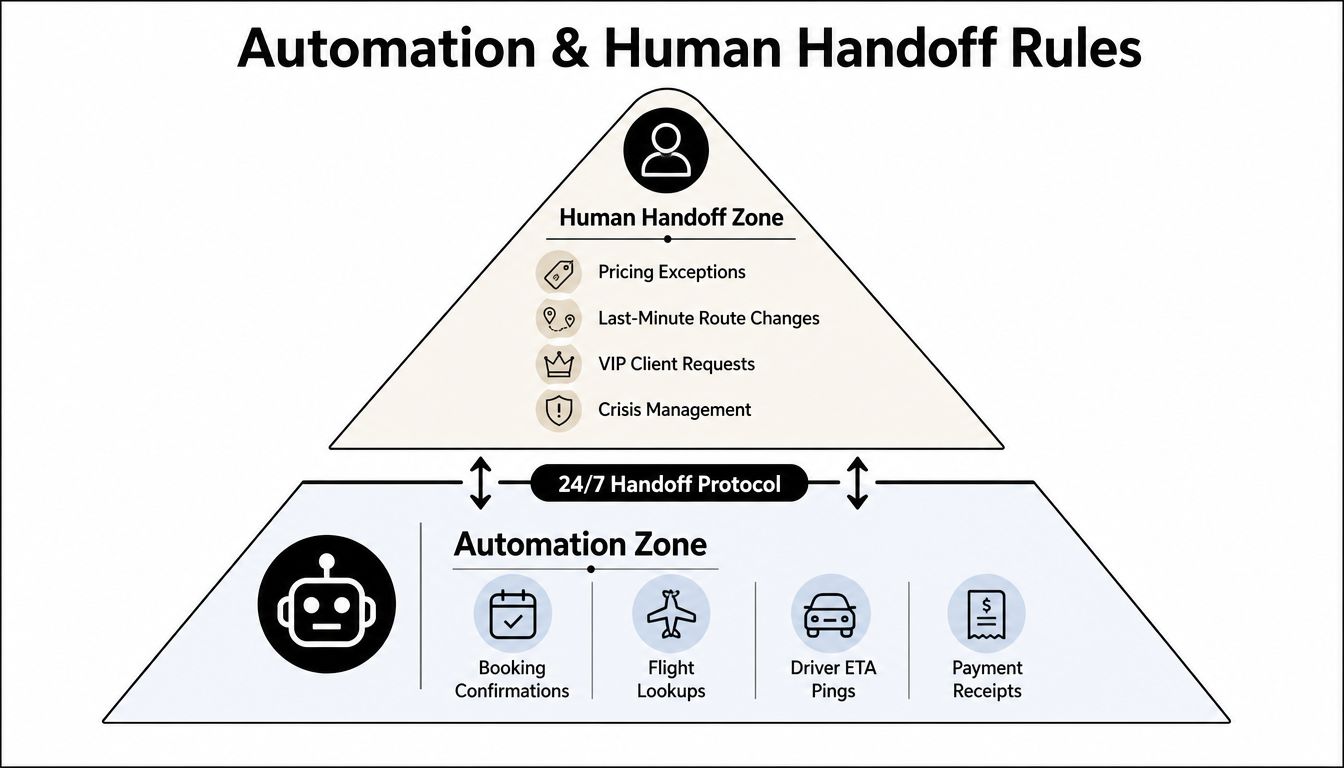
Automation earns its keep when the message is routine, the risk is low, and the client can be updated without waiting on a person. That's the right place for booking confirmations, flight lookups, driver ETA pings, and payment receipts. The danger starts when automation is used to handle judgment calls that need context.
Draw the line before the client feels the break
A health-communication framework notes that more than 40 million Americans lack broadband access, and in rural and tribal areas 1 in 4 residents don't have reliable internet access. It also warns that if a webpage takes 10 seconds to load, the audience is likely lost (CommunicateHealth framework). For luxury transport, that means urgent updates should still work on plain SMS, weak airport Wi-Fi, or a basic phone connection.
Use automation for the first touch, not the final judgment. The bot can collect the booking number, confirm the flight, and open the case. Then it should name a human owner and hand off the context in one clean view. The human should open with what the system already knows, not with “Can you repeat that?”
What should never stay in automation
Some issues deserve human handling immediately. Pricing exceptions do. Last-minute route changes do. VIP preferences do. Any complaint does, because the client is usually asking about trust, not just logistics.
Automated tools should reduce repeat work, not reduce accountability.
For teams that want a practical email workflow reference, the email automation guide is useful for separating template logic from human review. That's the same principle that keeps dispatch clean. Let the software send the receipt or the routine update, then route the edge case to a person who can make a decision.
A good handoff rule is simple. Automation collects facts. A human owns outcomes. If a client ever has to restate the problem after the transfer, the handoff failed.
Training, Quality Checks, and KPIs That Prove It Is Working
Tone and empathy matter, but managers still need proof that the operation is getting better. The cleanest way to bridge that gap is to audit a small sample of real interactions every week, coach from what happened, and watch a short list of metrics that show whether responsiveness is holding under pressure.
QA should look at behavior, not just politeness
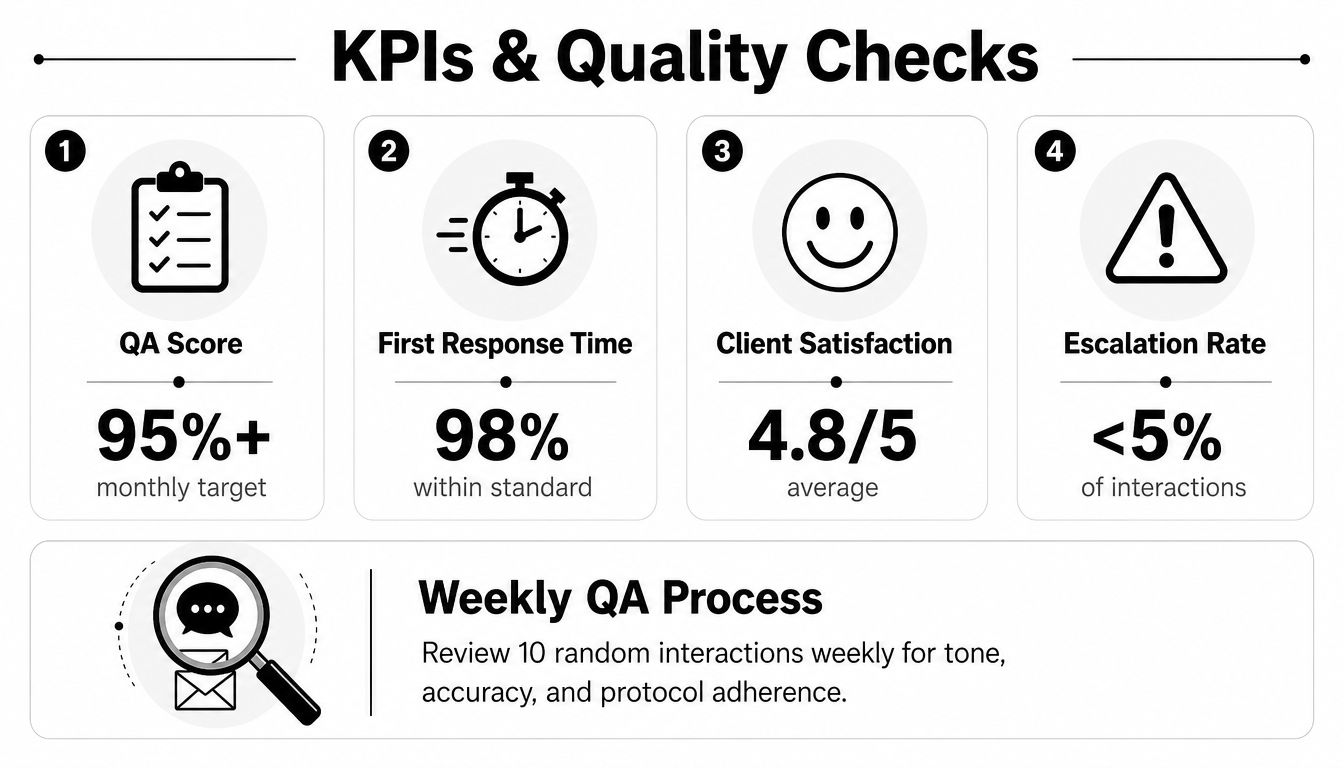
A weekly quality review can be short and still useful. Review a sample of calls, chats, and emails, then score them on a simple five-point rubric for tone, accuracy, ownership, speed, and follow-through. That gives you a repeatable way to spot whether agents are answering quickly but missing the handoff, or sounding warm but failing to close the loop.
Monthly ride-alongs and call-shadowing are still worth doing for newer staff. They reveal the moments a script can't teach on its own, like how to handle a tense corporate assistant, or how to speak to a wedding planner who is already juggling three vendors.
The KPIs that tell the truth
The most useful numbers are the ones tied to customer experience and operational discipline. Watch first-response time by channel, resolution time, repeat-contact rate, on-time performance tied to communication, and post-trip feedback. If a delay update was missed and a pickup was affected, that should show up in the review, not just in anecdotal complaints.
The office dashboard doesn't need to be crowded. A manager should be able to scan it in five minutes and ask a few hard questions. Are calls being answered within standard? Are repeat contacts climbing because the first answer is incomplete? Are missed pickups linked to communication failures or to dispatch errors? Are feedback scores slipping on one channel more than the others?
The point of QA is not to police tone. It is to catch the exact moment when the client stopped feeling informed.
A 30-Day Plan to Make Your Operation Truly Responsive
Many teams don't need new software to improve responsive communication. They need clearer ownership, cleaner scripts, and a month of disciplined implementation. This is enough to expose where the seams are and fix the parts clients feel.
A rollout that small teams can finish
Week one is audit week. Document how long calls, texts, and emails are taking now, and record the most common failure modes, like missed callbacks, unclear ownership, or inconsistent updates. Week two is standards week. Publish channel ownership, response targets, and escalation rules so everyone knows which message belongs where.
Week three is message week. Deploy templates for confirmations, delay alerts, meet-and-greet instructions, wedding timeline changes, and complaint responses. If your team handles special events, it helps to build a timeline with Ticketsmith so the communication plan matches the live schedule instead of fighting it.
Week four is measurement week. Launch a simple QA review, put the KPIs on one page, and review the dashboard with the team. The goal is not perfection. The goal is to make the process visible enough that problems stop hiding.
Pin this checklist in the dispatch room
- Name one owner for every live trip and every inbound message.
- Match the channel to the job, not to whoever happens to be online.
- Escalate early when money, timing, or VIP preference changes.
- Document every handoff so the client never has to repeat themselves.
- Review real interactions weekly and coach from what happened.
Responsive communication is a property of the operation, not a personality trait of the employee on duty. The teams that win on service design for reliability, then train the team to deliver it the same way every time.
If you want Max's Luxury Rides Inc. to feel more predictable on the busiest airport runs, roadshows, and event days, start with one dispatcher, one shared script set, and one weekly QA review. Then test the system on your next live itinerary change and tighten the handoff until the client never sees the seam.