
The ceremony starts in an hour. The bridal party is split between two hotels, the photographer is waiting at the venue, and the guest shuttle is stuck outside the reception because nobody confirmed where it should stage. Meanwhile, relatives are calling the couple for directions, attendants are searching for parking, and the timeline is losing the minutes it can't spare.
That situation isn't caused by choosing the wrong color of bus. It comes from treating wedding transportation as a final-week detail instead of a coordinated operating plan. A wedding party bus rental has to move people, protect the schedule, and handle the practical risks that appear when formal clothing, multiple venues, traffic, and alcohol enter the same day.
The Knot's 2024 Real Weddings Study, based on nearly 17,000 couples, found that couples spent an average of $1,075 on wedding transportation overall. That average reached nearly $1,200 for weddings with more than 100 guests, while hometown weddings averaged $1,044. The Knot's wedding transportation cost guidance also reports regional averages from $1,500 in the Northeast and New England to $755 in the Southwest, so geography matters as much as vehicle style.
Your transportation plan has three jobs: move the wedding party without creating panic, keep guests moving between locations on schedule, and provide a safe end-of-night ride home. The sections below turn those jobs into decisions you can put in a quote request, timeline, and contract.
Why Wedding Party Bus Rentals Need Real Planning
Transportation affects more than the ride itself. If the bridal party arrives late, the photographer loses planned portrait time. If guests can't find the reception entrance, the venue team fields avoidable questions. If the final ride home isn't organized, guests make individual decisions at the most tiring and alcohol-heavy point of the evening.
A good transportation plan assigns a vehicle, driver, pickup point, and responsible contact to every movement. It also distinguishes between a bridal-party transfer, a guest shuttle loop, and an after-party or hotel return. Those are different jobs, and one vehicle may not be the right tool for all of them.
The three assignments that matter
- Bridal party movement: Cover hotel, salon, venue, photo-location, and ceremony transfers. The vehicle needs reliable staging space and enough room for formal clothing, personal items, and attendants who must stay together.
- Guest circulation: Move guests from hotels to the ceremony, then from the ceremony to the reception or cocktail-hour location. A shuttle works best when pickup instructions are simple and the venue has a clear loading area.
- End-of-night transportation: Establish where guests go after the reception, whether that's a hotel loop, an after-party, or a designated final drop-off. Don't leave this to rideshare availability.
The Knot's figures show why transportation deserves its own budget line. Couples already allocate meaningful money to it, and larger guest counts tend to create more complex, shuttle-style logistics. A bus can reduce parking pressure and keep groups together, but only if the route and headcount are accurate.
Practical rule: Transportation isn't successful because the vehicle looks impressive. It's successful when the right people are at the right location before the next scheduled event.
Treat the plan with the same discipline you use for catering or photography. Share a written schedule with the planner, photographer, venue coordinator, dispatcher, and chauffeur. If you're also considering guest entertainment such as the benefits of a wedding photo booth, coordinate its delivery and setup separately so it doesn't compete with passenger loading space or arrival timing.
Sizing Your Vehicle to Your Group
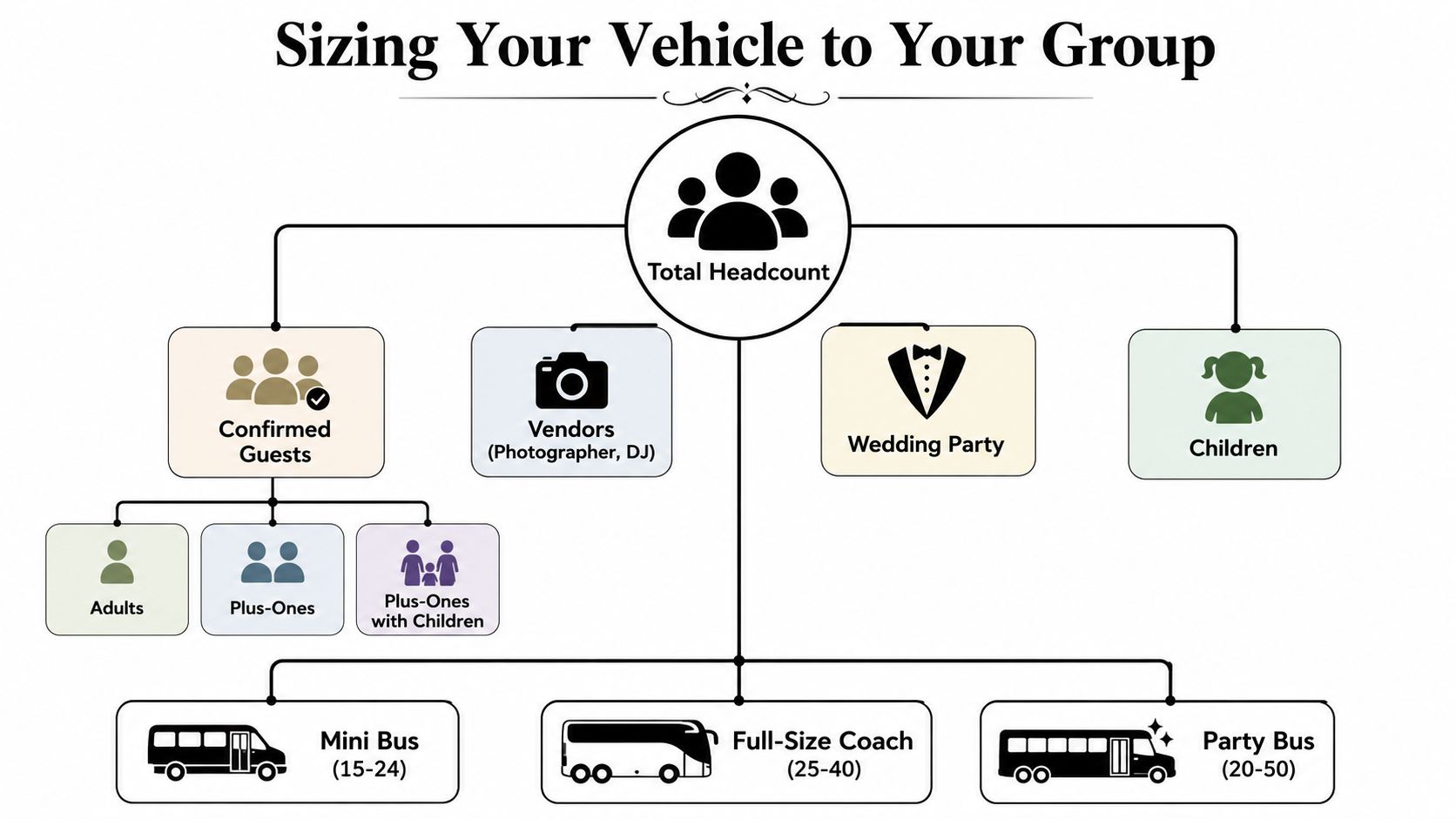
A wedding shuttle can look spacious at the depot and feel cramped once formalwear, bags, and attendants fill every seat. Build the passenger plan around each movement, then choose a vehicle that meets its certified capacity and comfort needs. Count plus-ones, children, attendants, and vendors who require transportation, not only the people shown in the wedding-party photo.
Common planning tiers place small units at about 10 to 16 passengers, medium units at about 17 to 30, and large units at about 31 to 50 or more, according to this party bus capacity guide. Treat those ranges as starting categories. The operator's certified seat count controls the booking, and it also matters for insurance and compliance checks.
Build the headcount honestly
Prepare a separate list for every scheduled movement:
- Confirmed guests: Count adults, plus-ones, and children who will ride.
- Wedding party: Add bridesmaids, groomsmen, attendants, parents, and anyone assigned to the couple.
- Vendors: Include the photographer, DJ, coordinator, or other vendors only when they need seats.
- Special items: Flag garment bags, mobility equipment, luggage, and décor that will occupy usable space.
Compare each total with the vehicle's certified capacity and seat-belt count. An interior may appear to have standing room, but standing space does not raise the legal passenger limit. A party bus capacity guide for renters recommends leaving 4 to 6 unused seats when formal clothing, aisle movement, and personal belongings affect comfort.
That buffer is a comfort recommendation, not a legal requirement. Maximum occupancy can still mean pressed dresses, jackets, bags, and passengers during the ride.
Split borderline groups instead of overloading
When the count approaches the certified maximum, split the movement. Assign one vehicle to the wedding party and another to the guest loop, or stagger departures only when the route has enough time for traffic and venue delays.
Request the certified capacity in writing. Confirm whether the stated number includes the driver, and require the exact vehicle assignment in the quote instead of accepting “large bus.” Legal capacity and available seat belts are the standard. Physical fit alone does not satisfy a wedding transportation plan.
Matching Max's Fleet to Each Wedding Role
Vehicle choice should follow the assignment, not the brochure. A couple's private transfer needs privacy and easy access, while a hotel shuttle needs repeat circulation and efficient loading. Assigning one oversized vehicle to every movement can raise the bill and create problems at narrow streets, hotel loading zones, and crowded venues.
Max's fleet includes executive sedans, luxury SUVs, Mercedes vans, Sprinter limousines, executive shuttles, stretch limousines, minibuses, mini coaches, and full-size coach buses. Match each category to passenger count, privacy, route complexity, luggage, and the time the vehicle must remain in circulation.
| Wedding Role | Recommended Vehicle | Planning Standard |
|---|---|---|
| Couple's private transfer | Executive sedan or luxury SUV | Couple plus any assigned attendants |
| VIP family movement | Luxury SUV or executive sedan | Small private group |
| Immediate bridal party | Mercedes van or Sprinter limousine | Small to mid-size group |
| Bridal party with photo equipment or wardrobe | Sprinter limousine or executive shuttle | Mid-size group with usable storage |
| Ceremony to reception guest loop | Executive shuttle or minibus | Mid-size group with repeated trips |
| Larger guest movement | Minibus or mini coach | Large group, subject to certified capacity |
| Guest count above 40 | Full-size coach bus | Large group, subject to certified capacity |
| Photo-focused entrance or exit | Stretch limousine | Small group where appearance matters |
Use private vehicles for private movements
An executive sedan or luxury SUV is the right call when the couple needs a quiet, direct ride. It can reach narrow streets and hotel loading areas that may be difficult for a larger bus. Parents and VIP guests also get a controlled transfer instead of joining a broader shuttle circuit.
A Mercedes van or Sprinter limousine fits the immediate bridal party when everyone needs to travel together. Use it for hotel-to-venue transfers, salon pickups, or a dedicated photo route. Formalwear, garment bags, and personal items reduce usable space, so choose by comfortable seating and storage, not the tightest physical fit.
Confirm the certified capacity and seat-belt count before signing. Ask whether the listed capacity includes the driver, and require the exact vehicle assignment in the quote. “Large bus” is not a usable specification for a wedding plan.
Reserve shuttle vehicles for circulation
The executive shuttle or minibus usually handles hotel, ceremony, cocktail-hour, and reception loops. It supports repeated trips while keeping the largest coach available for movements that require it. Give the operator the full route, stop order, loading locations, and expected turnaround time so the assigned vehicle matches the schedule.
A stretch limousine earns its place when the vehicle is part of the entrance, exit, or photo plan. It is a poor fit for fast loading, larger groups, or repeated venue stops. For guest movement above 40 people, a full-size coach is the practical choice, provided its certified capacity, insurance requirements, route access, and loading area all work. Ask for those details in writing before approving the reservation.
Pricing, Quotes, and the Actual Final Bill
Start vendor comparisons with the complete reservation cost. Wedding transportation pricing changes with duration, day of week, vehicle type, route complexity, fuel, tolls, gratuity, cleaning requirements, and overtime rules. An advertised hourly rate may cover only driving time, while the invoice includes the operator's full commitment to vehicles, staff, waiting time, and repositioning.
The Knot's 2024 study gives couples a useful national planning benchmark, with average wedding transportation spending at $1,075. That figure covers wedding transportation overall, not a guaranteed party bus rate. Regional averages range from $755 in the Southwest to $1,500 in the Northeast and New England. Use those figures to test whether your budget is realistic, then compare itemized proposals rather than demanding a matching price.
Compare the booking models
A short photo-transfer reservation can suit the couple or bridal party traveling between selected locations. A full-day guest shuttle requires the operator to reserve vehicles and staff for repeated movements, including periods when the bus waits at the venue. Compare these services by total operating time and responsibilities, not by the hourly figure alone.
Duration and day of week can change private-event pricing sharply. Recent reporting from India listed a 2-hour pre-wedding shoot at Rs12,000 plus GST on weekdays and Rs16,000 plus GST on weekends. 5-hour private-event bookings were reported at Rs26,000 to Rs28,000 plus GST, while full-day bookings reached Rs32,000 to Rs40,000 plus GST, according to The Hans India. These India-specific examples are not U.S. quotes. They demonstrate why service duration and peak dates belong in the initial vendor discussion.
Ask each operator these questions before comparing proposals:
- Hourly minimum: How many billable hours apply, including wait time and repositioning?
- Inclusions: Does the quote include the assigned vehicle, chauffeur, fuel, tolls, standard amenities, insurance, and gratuity?
- Automatic surcharges: What triggers overtime, after-hours billing, cleaning charges, cancellation fees, or route-change costs?
Request an itemized final price. Require every verbal promise, including vehicle type and capacity, to appear in the contract. A low quote can omit charges that another operator already included, so judge the proposal by its contracted total and compliance details, not its opening rate.
Building the Wedding-Day Transportation Timeline
A transportation timeline should identify the vehicle's location, passenger load, destination, staging point, and responsible contact for every movement. “Pick up the bridal party at the hotel” isn't enough. The chauffeur needs the exact address, entrance, loading instructions, passenger list, and departure time.
Build the schedule backward from fixed events. Ceremony start time, photography appointments, reception access, and venue closing rules don't move easily. Pickup times can move, but only if you protect enough room for preparation delays, traffic, loading, and a missed turn.
A practical movement template
- Getting-ready pickup: Set the vehicle at the correct hotel entrance and confirm whether passengers need help with bags or garment storage.
- Ceremony arrival: Schedule arrival early enough for unloading, restroom stops, and the walk to the ceremony space. Don't plan a curbside arrival at the exact ceremony start.
- Photo transfer: Keep the couple's vehicle separate from the guest shuttle when the photographer has a precise location plan. A private vehicle can depart quickly without waiting for a full load.
- Reception loop: Give guests clear instructions about the next departure. The venue coordinator should know where the bus will stage and who can authorize a route change.
- After-party return: Define the final destination before the reception begins. Tell guests whether the vehicle runs a continuous loop or leaves at fixed departure times.
Use a written wedding schedule template, such as this Australian wedding schedule template, as a planning aid, then adapt it to your local route and venue rules. The template won't replace a transportation dispatch sheet, but it can help align preparation, ceremony, photos, reception, and departure activities.
Put one person in charge
Choose one transportation contact who isn't the couple. That person should communicate with the chauffeur, photographer, planner, and venue coordinator. When five people give the driver separate instructions, the schedule becomes impossible to control.
Defend against common delays by assigning a clear response:
- Hair and makeup runs late: The planner decides who can travel first and who must follow.
- Traffic changes: The dispatcher updates the route while the chauffeur focuses on driving.
- Venue loading confusion: The coordinator confirms the staging area before the vehicle arrives.
- Passengers wander: The designated contact gathers the group and performs a head count.
- The reception ends unevenly: The driver follows the agreed departure plan instead of waiting indefinitely without authorization.
Write times as both departure and arrival targets. A bus that arrives early but can't legally or safely stage may still create a problem, so include the venue's instructions in the driver packet.
Contracts, Insurance, and the Legal Stuff
A polished vehicle doesn't prove that the operator has the right insurance or that the booking complies with passenger rules. Ask for documentation before signing, especially when the vehicle will cross state lines or carry a large group.
For interstate for-hire passenger transportation in major U.S. markets, the financial-responsibility threshold depends on certified seating capacity. Vehicles with 15 or fewer seats, including the driver, require $1.5 million in coverage, while vehicles with 16 or more seats require $5 million, according to the safety and insurance guidance provided by this passenger transportation compliance resource.
Verify the vehicle, not the marketing label
A “16-passenger party bus” can trigger a different insurance category from a 15-seat vehicle. Confirm the certified seat count, the number of seat belts, and the operator's applicable coverage. Interior standing room, bench arrangement, and decorative layout don't increase legal capacity.
The operator should also explain whether the policy is primary coverage, excess coverage, or another arrangement. Don't accept a general statement that the company is “fully insured” when your planner or venue requires proof of specific limits.
Treat alcohol as a compliance issue
Alcohol rules vary by state and by service arrangement. Washington state law provides a particularly clear example. The carrier must determine whether alcohol will be served, keep the liquor permit with the contract of carriage, and remove alcohol if conditions become unsafe. Violations can carry penalties of up to $5,000 per violation, as described in the relevant Washington wedding transportation alcohol guidance.
That requirement isn't a universal rule for every state. It is a warning against assuming that a party bus's beverage setup automatically makes alcohol service lawful. Ask who supplies the alcohol, who holds the permit, where the permit is recorded, and what the chauffeur can do if passengers become unsafe.
Your contract should state:
- Cancellation and rescheduling: Identify deadlines, credits, refunds, and weather procedures.
- Damage and cleaning: Define passenger responsibility and any waiver or deposit.
- Overtime: State the billing rate, authorization process, and minimum increment.
- Capacity: Name the certified passenger limit and seat-belt requirement.
- Vehicle assignment: Specify the promised class or exact vehicle, plus the remedy for substitution.
Your Wedding Party Bus Rental Checklist
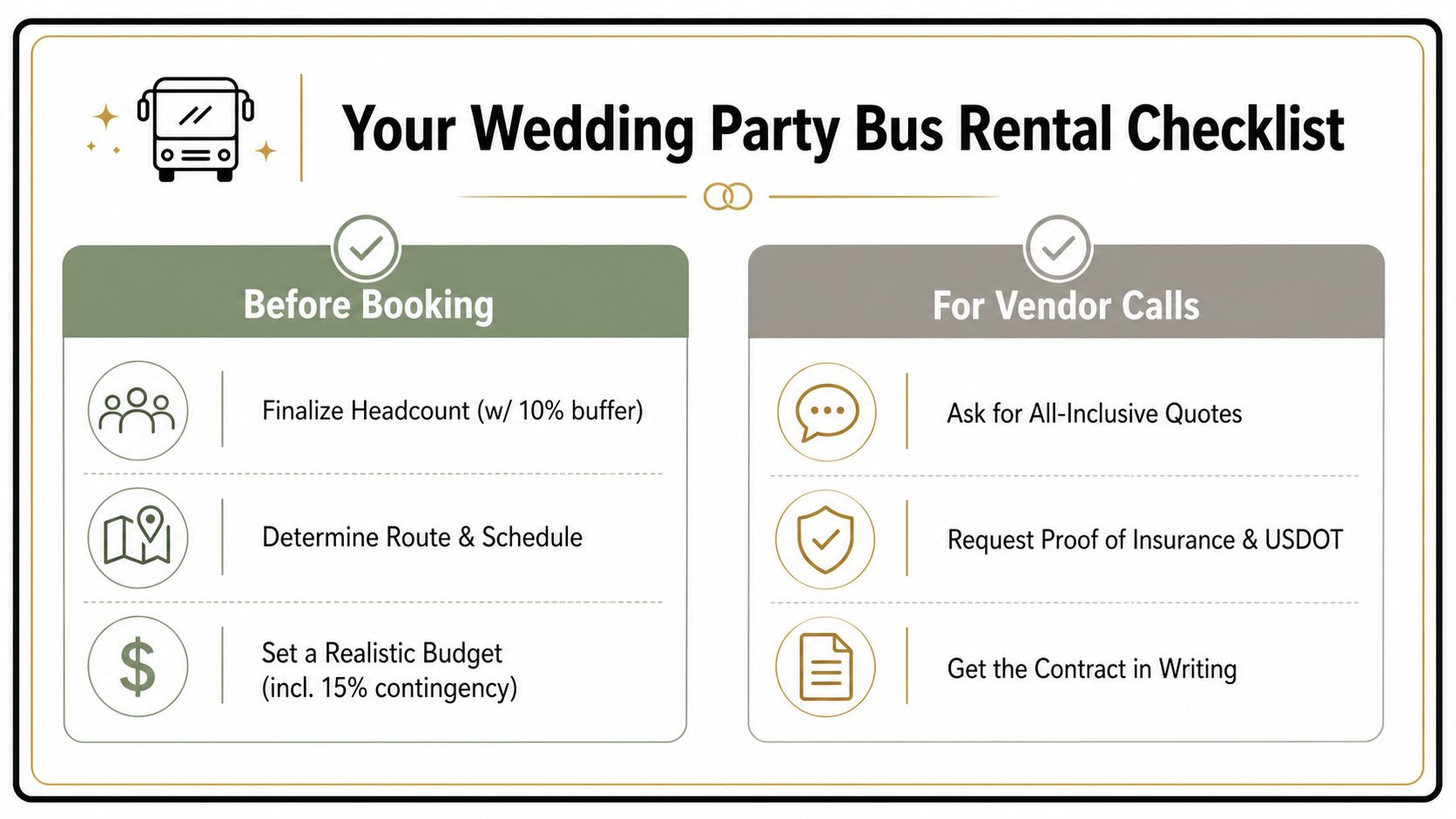
Use this checklist during vendor calls and in the week before the wedding. A transportation plan is ready when another person can read it and operate the day without calling the couple for basic instructions.
- Headcount: Who rides each leg, including plus-ones, children, attendants, and vendors?
- Vehicle class: What is the certified capacity, and which seats remain open for comfort?
- Wedding role: Is the vehicle assigned to the couple, bridal party, guest loop, or after-party return?
- Quote: What are the minimum hours, inclusions, fuel or toll terms, gratuity policy, and surcharge triggers?
- Timeline: What are the exact pickup addresses, staging points, departure targets, and final drop-off?
- Compliance: Can the operator provide proof of insurance and explain alcohol procedures for the event's state?
- Contract: Are cancellation, damage, capacity, substitution, and overtime terms written clearly?
During the final week, reconfirm every pickup address, venue loading instruction, passenger contact, chauffeur contact, and after-party destination. Give the planner or dispatcher the latest headcount and tell guests exactly where to wait. Max's Luxury Rides Inc. offers wedding transportation using options such as luxury SUVs, Mercedes vans, Sprinter limousines, shuttles, minibuses, mini coaches, and full-size coaches, so couples and planners can match vehicles to separate wedding-day roles. Visit Max's Luxury Rides Inc. with your route, headcount, and timeline ready, and request a written quote that addresses capacity, insurance, inclusions, and overtime before you book.