
A corporate travel manager gets the request at 4:30 p.m. A VIP attendee arrives the next morning, uses a power wheelchair, and needs a direct airport transfer to the hotel. The usual sedan won't work, the first van provider can't confirm the chair's dimensions, and an event shuttle has a lift but no verified securement position. The reservation may look complete in the booking system, yet the transportation plan is still unconfirmed.
That situation is avoidable. Wheelchair accessible vehicles require operational planning, not just a checkbox on a reservation form. The vehicle's entry configuration, ramp or lift, interior clearance, securement equipment, driver preparation, and backup plan all affect whether the trip works at curbside.
Why Wheelchair Accessible Vehicles Matter More Than Ever
Accessible transportation is now a core responsibility for corporate travel teams, meeting planners, hotels, and event operators. A guest who uses a wheelchair shouldn't have to explain, at the curb, that the assigned vehicle can't accommodate a power chair. The provider should already know the mobility device, passenger position, pickup conditions, and required equipment before dispatch.
The scale of the need is substantial. One mobility-industry facts sheet reports that more than 2 million people need a wheelchair accessible vehicle, that demand grows 8% annually, and that only 4% have access to a private vehicle. These figures come from the Bridge to Mobility accessible-vehicle facts sheet, and they point to a persistent gap between transportation demand and available private access.
That gap becomes especially visible during conferences, sporting events, weddings, and peak airport periods. A provider may have accessible vehicles in its broader network, but that doesn't mean one is available at the required time, in the right configuration, or close enough to meet a tight pickup window.
The booking failure usually happens before dispatch
Most failures start with incomplete information. “Wheelchair accessible” can mean a manual chair, a large power chair, a tilt-in-space model, or a passenger who needs to remain seated in the chair throughout the trip. Those requirements aren't interchangeable.
A reliable request should identify:
- Mobility device: State whether the passenger uses a manual wheelchair, power wheelchair, scooter, or specialized chair.
- Passenger position: Confirm whether the guest will remain in the wheelchair or transfer to a vehicle seat.
- Trip environment: Note airport curbside pickup, hotel loading zones, event venues, parking garages, or narrow residential streets.
- Service pattern: Distinguish a single transfer from repeated shuttle movements with multiple boarding cycles.
Practical rule: Treat the accessible vehicle assignment like a technical specification, not a general preference.
The modern WAV market grew from specialized transport solutions. The history of wheelchair accessible vehicles reaches back to the mid-20th century, including Walter Harris Callow's adapted bus in 1947 and Ralph Braun's raised-top, raised-door van conversion in 1973, as documented by Ransome Wavs' history of WAVs. Today's fleet choices are more standardized, but the underlying lesson remains the same: the vehicle must be designed around the passenger's actual mobility needs.
Types of Wheelchair Accessible Vehicles Explained
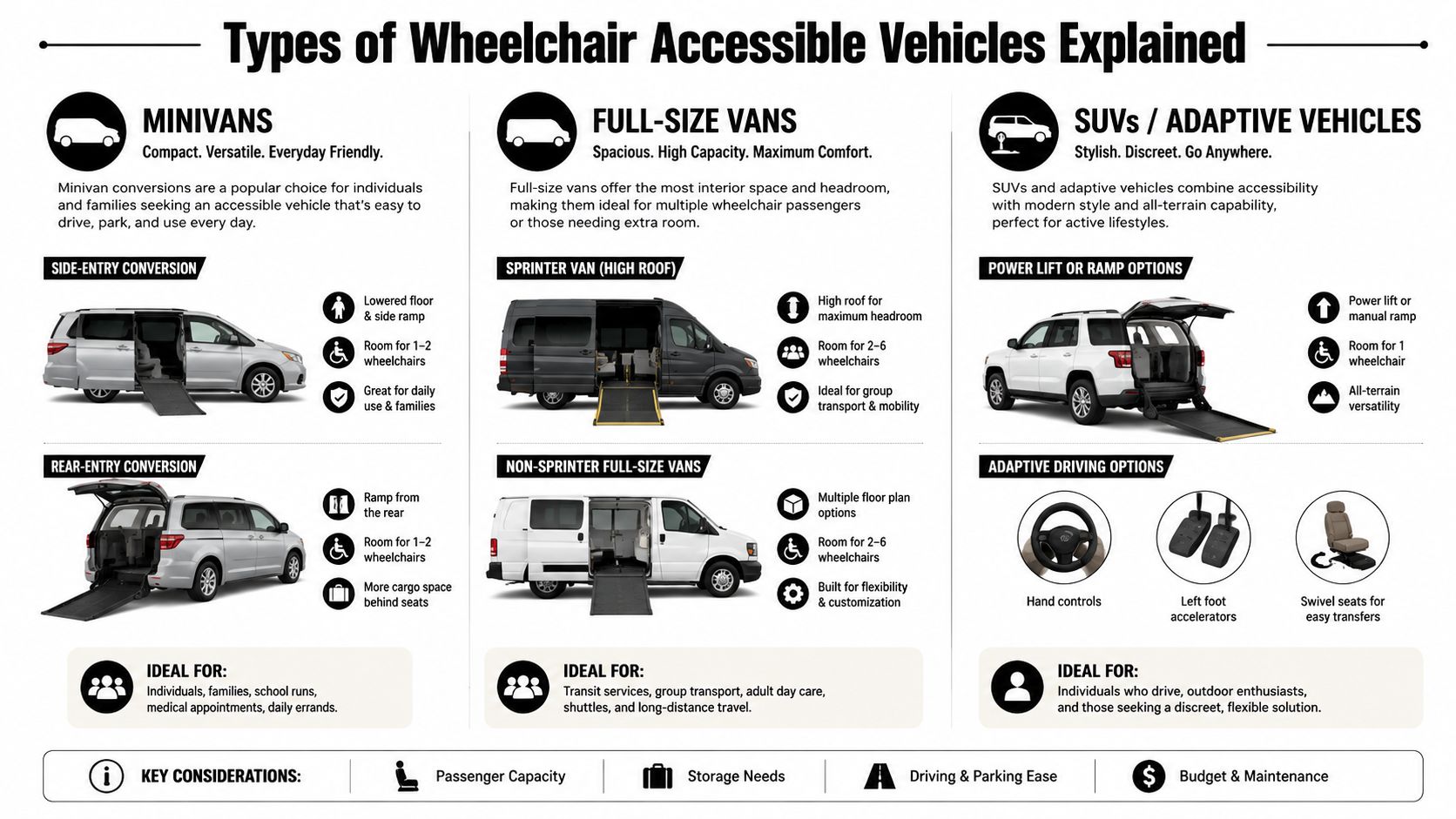
Vehicle categories solve different transportation problems. A minivan may be ideal for one guest and a companion, while a full-size shuttle is the wrong choice if the venue has a restrictive garage height. Corporate planners should select the platform first, then confirm the conversion details.
Minivans
Side-entry minivans load through the sliding door and usually offer the most flexible passenger positioning. They can work well when a wheelchair user needs the front passenger position, wants easier interaction with companions, or may use adaptive driving equipment. The tradeoff is operational. Side-entry ramps need usable space beside the vehicle, which can be difficult at crowded airport curbs or tightly packed event lots.
Rear-entry minivans load from the back and create a straight boarding path. They're often practical for caregiver-driven trips, hotel transfers, and locations where side clearance is unpredictable. The passenger commonly remains in a rear or second-row wheelchair position, so the planner should confirm the exact seating layout rather than assuming every rear-entry conversion has the same cabin capacity.
For airport transfers involving one wheelchair user and a small party, a converted minivan is usually the first category to investigate. Confirm luggage capacity separately. A vehicle that accommodates the passenger may not have enough room for multiple large cases after the ramp and securement area are occupied.
Full-size vans and Sprinter configurations
Ford Transit, Ram ProMaster, and Mercedes Sprinter-style vehicles provide more vertical and floor space than minivans. They're better suited to multiple wheelchair positions, larger groups, attendants, and long event movements, but their exterior dimensions create new constraints. Check roof height, vehicle length, turning access, loading-zone restrictions, and garage clearance before booking.
A full-size accessible van can present a more polished solution for executive travel when it has appropriate seating, climate control, lighting, and a clean interior. Don't assume that “Sprinter” means executive accessible transport. The conversion layout determines whether the wheelchair user has a comfortable position, whether companions can sit nearby, and whether luggage competes with usable cabin space.
Shuttle buses and coach conversions
Accessible shuttle buses make sense for conferences, campus movement, venue loops, and recurring employee transportation. They can handle more passengers and more complex boarding patterns, but planners must verify the number of wheelchair positions, lift location, aisle access, and whether the vehicle can serve passengers who remain in their chairs.
Coach conversions suit larger events, but they demand careful venue coordination. A coach may reach the destination while still failing at the final loading point because of road grade, curb geometry, overhead clearance, or limited lift deployment space. For group programs, request the vehicle layout, not merely the passenger count.
Adaptive SUVs
Adaptive SUVs can work for ambulatory passengers who need transfer assistance or for mobility equipment that folds and stores. They aren't a substitute for a true WAV when the passenger must remain seated in a wheelchair. Ask the provider to distinguish “mobility-friendly” from wheelchair-occupant accessible before accepting the vehicle.
Essential Accessibility Features to Verify
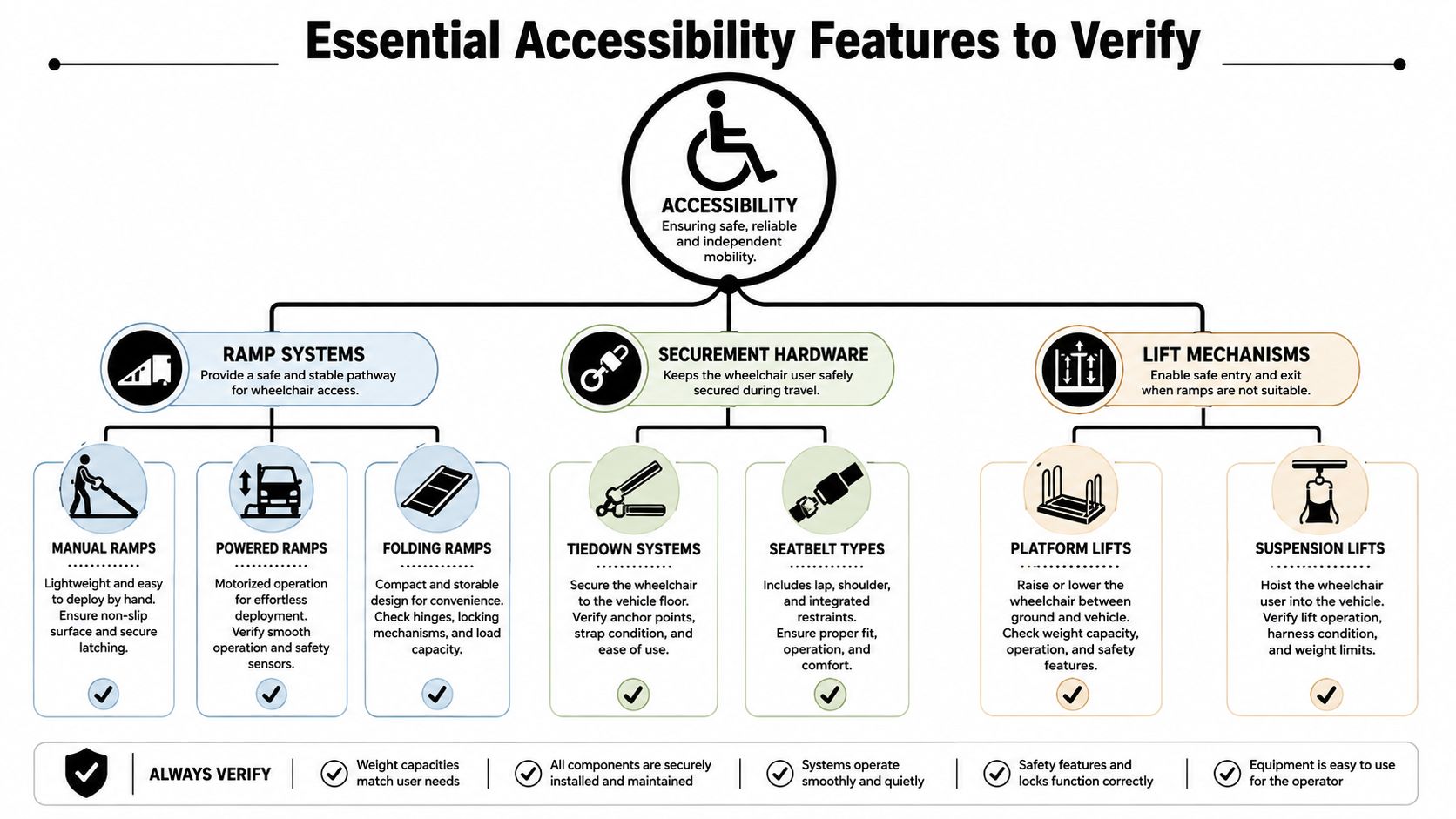
A vehicle can display a ramp and still be difficult to board. The important questions concern geometry, equipment condition, interior space, and securement. Ask for specifications that match the passenger and the pickup environment.
Ramp geometry affects the passenger experience
Ramp slope determines how much effort the passenger or attendant needs during boarding. U.S. accessibility guidance allows a maximum 1:4 slope when the vehicle floor is 3 inches or less above a 6-inch curb, a 1:6 slope when the floor is 3 to 6 inches above that curb, and 1:8 or flatter when the floor exceeds 6 inches, according to the National RTAP vehicle and facility accessibility guidance.
That distinction matters at curbside. A low-floor conversion can shorten deployment, reduce the incline, and make boarding more predictable when curb height and pavement pitch vary. Ask whether the provider has tested the ramp at the actual pickup area, especially if the passenger self-propels or an attendant will push a heavy chair.
For longer ramps, the same guidance requires support for 600 pounds at the centroid with a safety factor of at least 3 when the ramp is 30 inches or longer. Ramps shorter than 30 inches must support 300 pounds. A practical specification should also include a 30-inch clear ramp width, a continuous slip-resistant surface, and side barriers of at least 2 inches to reduce wheel-off risk.
Lifts, doorways, and interior clearance
Platform lifts are often appropriate for heavy power chairs or vehicles with higher floors. Confirm platform dimensions, deployment space, backup operation, and whether the lift can be used safely on the planned curb or driveway. A powered ramp may be faster for a low-floor minivan, but a lift may offer the more reliable loading method for a heavier or larger mobility device.
Doorway width is only the first measurement. Record the chair's overall width, length, height, footrest position, and turning behavior. Then compare those measurements with the doorway, ramp, cabin height, and securement zone.
Securement is part of the booking
Request a four-point tie-down system or another approved securement method appropriate for the chair. Confirm that the vehicle also provides an occupant restraint belt and that the driver knows how to position both the chair and passenger. Securement hardware shouldn't force the chair into an awkward angle or block the ramp path for the next passenger.
A ramp gets the passenger inside. The securement system makes the trip viable.
ADA Compliance and Real-World Usability Gaps
ADA compliance is a baseline, not a usability guarantee. A vehicle can satisfy a minimum dimensional rule and still create slow boarding, difficult turning, or poor securement for a modern power chair.
Independent transportation-safety research explains that the legacy wheelchair space standard uses a clear floor area of 760 millimeters by 1220 millimeters, or 30 inches by 48 inches, based on common wheelchair dimensions from the 1970s. The transportation-safety research published through PMC highlights why that benchmark can be inadequate for larger power chairs and tilt-in-space models.
Test the complete movement path
A booking agent who verifies only the ramp width has checked the least complete part of the journey. The passenger must approach the ramp, cross the threshold, turn or align inside the cabin, reach the securement zone, and remain clear of seats, trim, restraints, and other equipment.
For fleet selection, test the vehicle with the actual devices most commonly served. For one-off bookings, send the provider the chair model or precise measurements and request confirmation from the dispatch or operations team, not only a general customer-service representative.
Use this evaluation sequence:
- Measure the device: Include width at the widest point, total length, occupied height, and any raised back or leg supports.
- Confirm the approach: Check whether the ramp can deploy straight and whether the passenger can reach the doorway without a sharp turn.
- Verify the interior envelope: Ask where the chair will sit and whether the cabin allows comfortable alignment.
- Review securement access: Confirm that tie-down points and restraint belts can be reached without moving the passenger unnecessarily.
- Run a practical test: Have the provider demonstrate boarding and securement before committing a recurring fleet program.
Event planners should also ask about the venue itself. A compliant vehicle still needs enough curbside room to deploy its equipment. If the loading zone is blocked by cones, parked cars, or a steep approach, the driver may not be able to use the system as intended.
Matching Vehicle Type to Your Specific Use Case
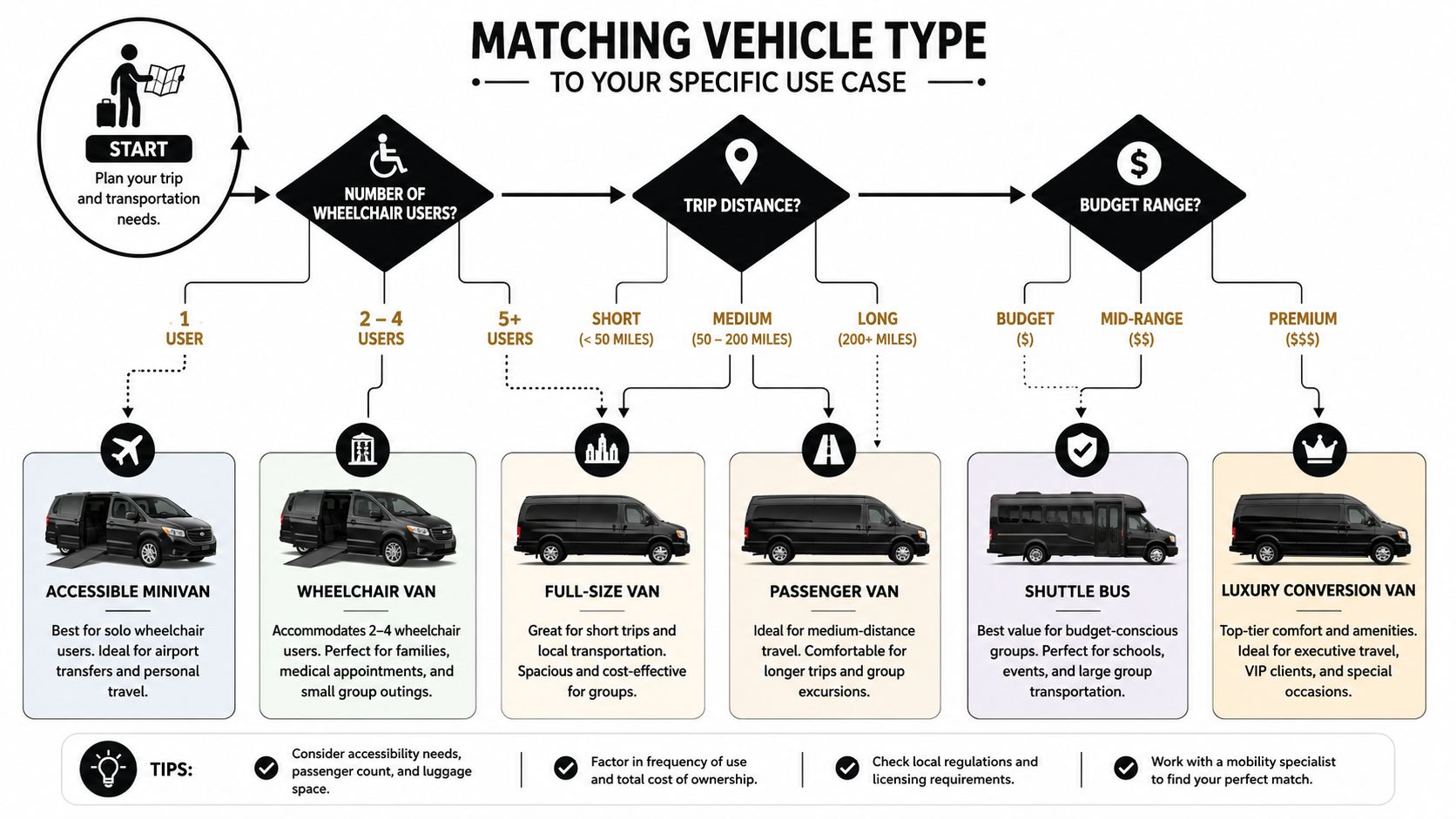
Start with the passenger, not the brand name. The right vehicle depends on who is traveling, how many mobility devices are present, where boarding occurs, and how often the vehicle must repeat the movement.
Airport transfers
For one wheelchair user with a companion, begin with a converted minivan if the chair fits the documented doorway and securement area. Choose side-entry when front-row access or independent positioning matters. Choose rear-entry when the pickup zone is tight and the passenger will remain in a rear wheelchair position.
Luggage changes the answer. Ask the operator to account for checked bags, carry-ons, medical equipment, and attendants. A vehicle can technically carry the passenger while leaving no practical space for the group's luggage.
Corporate travel
Corporate transportation needs more than physical access. It needs precise flight monitoring, professional curbside handling, clean interiors, and a backup plan if equipment fails. A full-size accessible van may suit a small executive group, but only if the interior layout gives the wheelchair user an appropriate position rather than placing the guest apart from colleagues.
Send the provider a passenger manifest that identifies the wheelchair user discreetly and accurately. Avoid vague notes such as “special assistance.” State the required vehicle type, boarding method, chair dimensions, and whether the guest transfers.
Use the embedded video as a visual supplement when discussing accessible vehicle selection with colleagues or venue partners:
Weddings and special occasions
For weddings, comfort and presentation matter as much as capacity. A luxury accessible van or carefully configured shuttle can keep the guest with the wedding party, but planners must confirm floor space, climate control, step-free boarding, and room for formal clothing or equipment.
Never substitute a luxury SUV for a WAV unless the passenger can transfer safely and the wheelchair folds into the cargo area. A premium badge doesn't change the vehicle's access limitations.
Sporting events, concerts, and recurring routes
Large events favor shuttles or accessible minibuses when several guests need transport. Confirm wheelchair positions, boarding sequence, venue staging, and return-trip timing. A single accessible vehicle may become a bottleneck if every passenger must board separately and the route has a narrow departure window.
For recurring employee or guest routes, track actual boarding times and equipment issues. That operating record helps determine whether the fleet needs a larger vehicle, a second accessible unit, or a different loading schedule.
Understanding Costs and Budget Considerations
Accessible transportation pricing is difficult to compare because providers may quote only the ride, while ownership requires the vehicle, conversion, maintenance, insurance, cleaning, fuel, driver preparation, and downtime. The practical question isn't, “What does the van cost?” It's, “What will this transportation program cost to operate reliably?”
Recent market reporting often emphasizes industry size instead of the buyer's full expense picture. The Fact.MR wheelchair accessible vehicle market report identifies pricing and total-cost transparency as an underserved concern, particularly for families and corporate travelers comparing ownership, rental, and on-demand service.
Compare the three operating models
Purchase gives an organization control over scheduling and vehicle specifications. It also creates responsibility for conversion quality, preventive maintenance, replacement equipment, commercial insurance, driver training, storage, and downtime. A purchased vehicle only improves service if someone owns the operating discipline behind it.
Rental can work for a short program or a temporary need, but accessible rental inventory is limited and specifications vary. Ask for the exact vehicle, not a category promise. Confirm the ramp or lift, chair capacity, securement method, pickup instructions, damage policy, and what happens if the assigned vehicle develops an equipment fault.
On-demand transportation avoids capital ownership and shifts maintenance and dispatch responsibility to the provider. It can be the most practical approach for occasional trips, but the buyer must evaluate availability, response time, vehicle verification, cancellation terms, and whether the provider can support peak event demand.
Budget beyond the invoice
Build a trip budget that includes waiting time, parking or venue access fees, additional stops, cancellations, after-hours service, and contingency transport. For a fleet, add inspection schedules, cleaning protocols, tire and lift maintenance, insurance, replacement transportation, and driver instruction.
Interior condition also affects the guest experience and operational image. For general guidance on cleaning high-touch vehicle surfaces and maintaining cabin presentation, planners can consult this GP Mobile Car Wash interior detail guide, then confirm that any cleaning process is compatible with ramps, tie-downs, upholstery, and accessibility equipment.
Demand pressure can affect both price and availability. The mobility-industry facts sheet cited earlier reports more than 2 million people searching for a wheelchair accessible vehicle and only 4% with access to a private vehicle. That shortage makes early reservations and written vehicle confirmation more valuable during conferences, holidays, and major events.
Your Pre-Booking Checklist for Accessible Transport
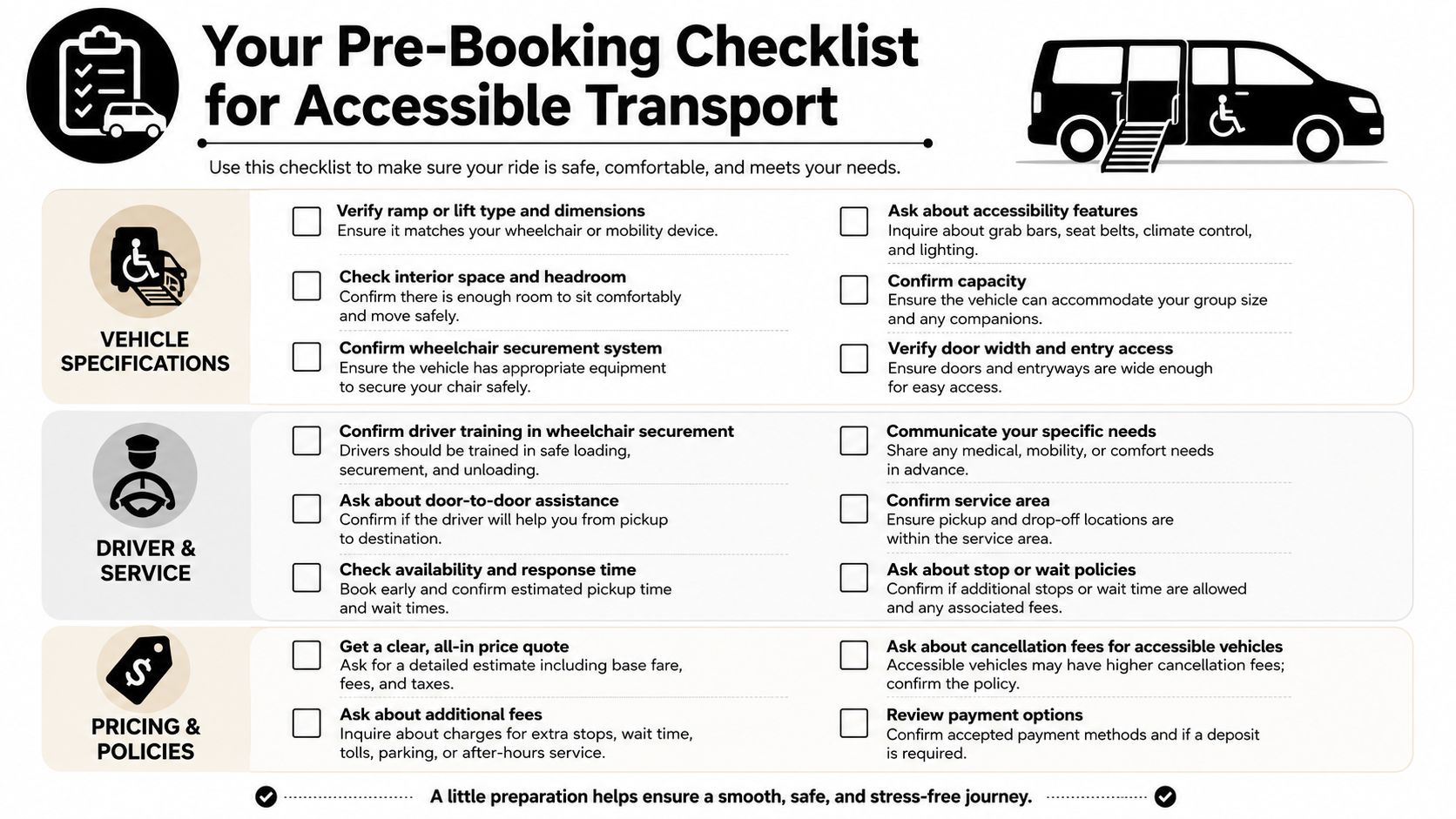
A successful reservation ends with a documented vehicle match. Don't accept “yes, we have an accessible van” as confirmation. Ask questions that force the provider to identify the actual vehicle and equipment assigned to the trip.
Send a complete passenger brief
Include the wheelchair or scooter type, dimensions, weight if relevant to the lift or ramp, passenger height, transfer requirements, number of companions, luggage volume, and whether the passenger remains seated in the device. Share the pickup address, loading-zone details, destination access information, and any tight timing constraints.
Then request the vehicle's make or class, entry configuration, ramp or lift type, clear doorway dimensions, interior headroom, securement arrangement, and usable wheelchair positions. Ask the provider to confirm those details in writing.
Verify the human service
Equipment doesn't operate itself. Confirm that the assigned chauffeur or driver has experience with wheelchair securement, ramp or lift deployment, passenger communication, and airport or venue loading procedures. Ask who will contact the travel manager if the vehicle becomes unavailable.
Use this short operational checklist:
- Confirm the assigned vehicle: Get the specific configuration, not only “WAV.”
- Check the access equipment: Verify ramp or lift type, clear width, deployment space, and backup operation.
- Match the chair: Compare the device measurements with the doorway, cabin, and securement zone.
- Review passenger restraints: Confirm the wheelchair securement system and occupant belt.
- Clarify loading conditions: Identify curb height, slope, parking restrictions, garage limits, and venue staging.
- Document the commercial terms: Ask about hourly minimums, waiting time, cancellation fees, damage responsibility, and replacement service.
- Create a confirmation trail: Obtain written confirmation shortly before travel and give the chauffeur a discreet passenger brief.
For recurring corporate or event work, add a pre-event test ride or vehicle inspection. That small step can expose a turning problem, luggage conflict, or lift limitation before guests arrive.
Max's Luxury Rides Inc. provides scheduled airport transfers, corporate transportation, special-event packages, executive vans, shuttles, minibuses, and coach options, with mobility requirements captured during reservation planning. Visit Max's Luxury Rides Inc. to discuss wheelchair space, vehicle configuration, passenger details, and a dependable transportation plan for your next trip.